agents
speech act
theory
gestalt
theory
computers
and fun
attention
human
memory
hci and
intelligent
systems
timing
and pace
Gestalt Theory
What are we talking about when we talk about Gestalt? To begin with, we are using a word of German origin. The term first appeared in 1523 in a translation from the Bible. Coming from a past participle (yor Augen gestelt), it meant something like: "before the eyes, exposed to the looks".
Today many authors prefer to talk about Gestaltung: the process of "taking shape" or "formation". They also agree that investigators Max Wertheimer (1880-1943), Kurt Koffka (1886-1941) and Wolfgang Kohler (1887-1967) were the first to turn this word into a theory.
Kohler was studying the behavior of superior primates.
Koffka was particularly interested in the relations between man and his medium.
Kohler, Koffka and Wertheimer were looking at psychologist Christian Von Ehrenfels(1859-1932) who had said: "THE WHOLE IS DIFFERENT FROM THE SUM OF THE PARTS".
This was going to be a central idea of Gestalt, for it would demonstrate
the fundamental importance of perception.
We are surrounded by sounds and forms that do not have a sole meaning. In a certain moment our perception is what-in that situation and
that instant-gives it a meaningful and dominant form. For instance,
what have we got here?
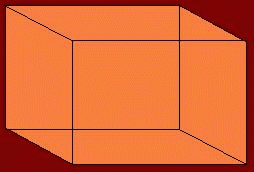
Actually, we have got 12 lines: 4 horizontal, 4 vertical and 4 oblique. That is what is objective. The cube is born out of our imagination. We see 12 lines, relate them to our memory of a cube and our perception creates the figure. This form, figure, Gestalt or project emerges from a background, in this case from our subconscious.
Around 1912 Wertheimer, Koffka and Kohler presented a conjunct study that is considered as the foundation of Gestalt Psychology.
Gestalt Psychology was born drawing its inspiration from phenomenology. This philosophical school's father was Edmund Husserl (1859-1938), whose central idea was to describe and not explain phenomena. The phenomena that the psychologist founders perceived and studied were visual and audible figures always external from the subject.
One of the fundamental things those pioneers noticed was that in all perceptive fields (that is to say the field sensuously noticed) you distinguish a background and a form.
The FORM is a dominant figure that gets its meaning on emerging from the background...
The BACKGROUND is a rear plane that gives meaning to the figure or form ...
However, perception of the form is not an objective fact. The subject isolates the figure according to his attention and his needs.

