agents
speech act
theory
gestalt
theory
computers
and fun
attention
human
memory
hci and
intelligent
systems
timing
and pace
As for Zen, a branch of Buddhism that originated a hundred years after Taoism and reached Japan in the 12th Century, this current sustains that the awakening or illumination (called satori) comes after an alert wait, a vigil with no purpose. "There are no rules, no intentions in Nature, whatever is, is, whatever comes, comes".
IT'S WHAT THE GESTALTISTS CALL DETACHMENT, OR CYCLE OF CONTACT AND WITHDRAWAL. THAT IS TO SAY: "DON'T PUSH THE RIVER, LET IT RUN" - Barry Stevens, great disciple of Perls.
Zen and the Gestalt, however, have their differences:
ZEN IS LEARNED WITH A GURU.
IN GESTALT THE CLIENT'S RESPONSIBILITY AND AUTONOMY MATTER.
IMMOBILITY IS ESSENTIAL IN ZEN.
MOVEMENT IS VALUED IN GESTALT.
IN ZEN RIGOROUS DISCIPLINE IS IMPERATIVE.
IN GESTALT SOME HEDONISM IS ALLOWED.
In the same way it has connections with oriental philosophies, Gestalt Therapy has connections with psychoanalysis as well, beyond Perls's rebelliousness against Freud.
Neurosis for Perls is due not to "pseudo memories of childhood", or forbidden or repressed desires of the superego, but to a series of unfinished (interrupted and unsatisfied needs) Gestalts in a relation between the organism (the person) and his medium.
While in psychoanalysis acting-out is considered a resistance to verbalization, in Gestalt premature verbalization is taken as a resistance to letting the feeling act-out and the appearance of deep associative experiences.
For psychoanalysis, resistance is all that prevents the access to the unconscious. For Gestalt, resistance-more than a wall to tear down- is a potential creative energy in order to live in a difficult world.
Besides these differences, Gestalt owes something to great psychoanalysts such as: Sandor Ferenczi (1873-1933). A pampered disciple of Freud, he was underrated by the "hard" orthodox due to his pluralist contributions. He gave great importance to the body and to the therapist's subjectivity and personal style. He established the analysts' obligatory supervision.
Carl Gustav Jung (1875-1961). Impeller of the humanist approach, he put the accent on the development of the self more than on the pathology. He proposed the therapist's active attitude and an intense relation with the patient. He prioritised the, internal dialogue ( interior drama) between the "personified" parts of the patient. He studied oriental philosophies, astrology and symbolism. Admired by Freud, Jung broke with him in 1912 following five years of hardships and deep arguments.
Gestalt finds certain things in common with other psychoanalysts,
MELANIE KLEIN (1892-1960). She gave importance to the corporal thing, introduced play therapy, and observed the ambivalence (or polarities) love-hate and good object-bad object.
OTTO RANK (1834-1939). He reduced the duration of treatments, took elements from the dream as the dreamer's projections, impelled the therapy of creativity.
KAREN HORNEY(1885-1952). She again valued the importance of the cultural medium and that of the present, and rescued the secondary benefits of the patient's existential problems. She gave the sessions, warm and secure climate.
DONALD WINNICOTT (1896-1971) He gave play and creativity a preponderant place, recognised the value of the phenomenal and the necessities, reduced interpretation's relevance, and valued-like Horney-warmth and security.
SERGE GINGER SAYS, "THE GESTALT IS ART AS WELL SCIENCE" AND AS SUCH IT IS ENRICHED WITH EACH ASSISTANT'S CONTRIBUTIONS.
(Founder of the Gestalt School of Paris, author of THE GESTALT: A THERAPY OF CONTACT).
According to Ginger's very creative synthesis, Gestalt would be in
the centre of a five point star. Each point; indicates a way to the humane, and the different therapeutic approaches are situated in a section of the star.
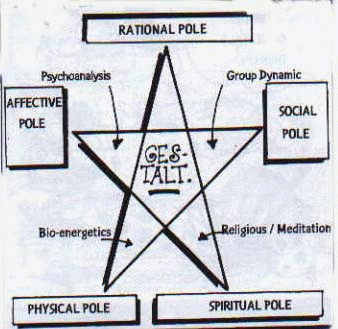
Gestalt appears in the centre because its approach is multidimensional and proposes interrelation of all the aspects without stalling at interpretations (why things are this way), but going straight to the operation (how things work).
And now, that will do for the story and theories.

